
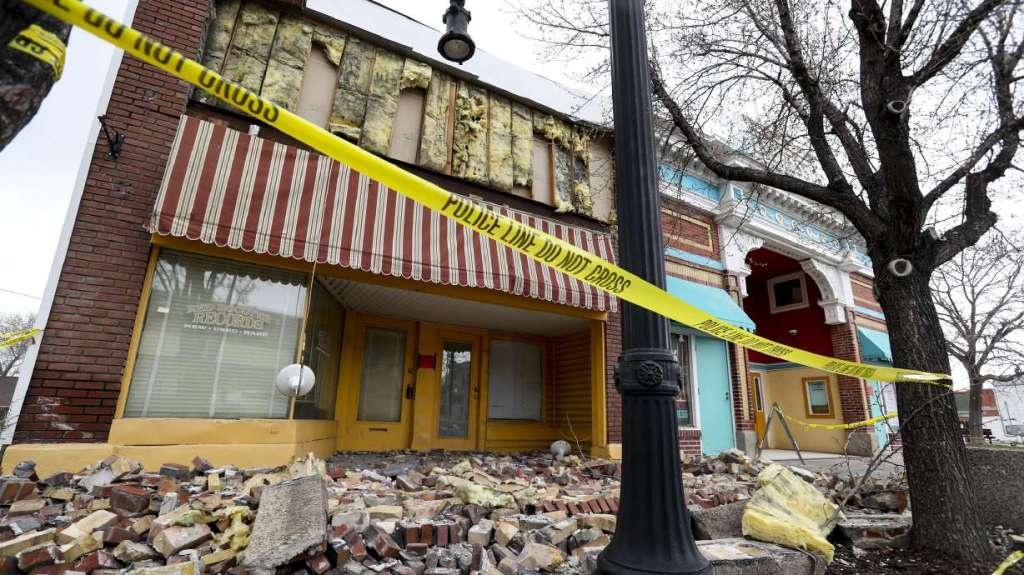
The Wasatch Front is home to about 2 million people. It’s also home to a fault line that is due for a major earthquake. In 2020 a magnitude 5.7 tumbler rocked the state and destroyed buildings just after Covid upended the world.
According to the US Geological Survey, “There is a 57% probability that the Wasatch Front region will experience at least one Magnitude (M) 6.0 or greater earthquake and a 43% probability of at least one M6.75 or greater earthquake in the next 50 years.”
If such a major earthquake were to happen during school hours, would our students be safe?
In 2006, a report was prepared for Alpine School District detailing the seismic needs of the schools in the district. 18 schools were rated as “very poor”. An additional 39 schools were rated as “poor”.
After 16 years, in 2022, the state of Utah issued an updated seismic report on all schools in the state that still had unreinforced masonry (URM). On that report, ASD had 11 schools listed, three of which were in the final stages of being resolved.
Currently, in 2024, these buildings are still listed in the report as having URM:
- Alpine Elementary
- Lehi Elementary
- Lindon Elementary
- Geneva Elementary (Orem)
- Windsor Elementary (Orem)
- Sharon Elementary (Orem) (closed in 2023)
- American Fork High School
- Pleasant Grove High School
These schools account for 7,678 students, plus staff. The cost to fix them? An estimated $282 million.
The 2022 proposed bond from ASD would have been directed to fix the two high schools. Additionally, there was an elementary rebuild or merger proposed, most likely for schools in Orem. The bond failed, however, so these projects have not been carried out.
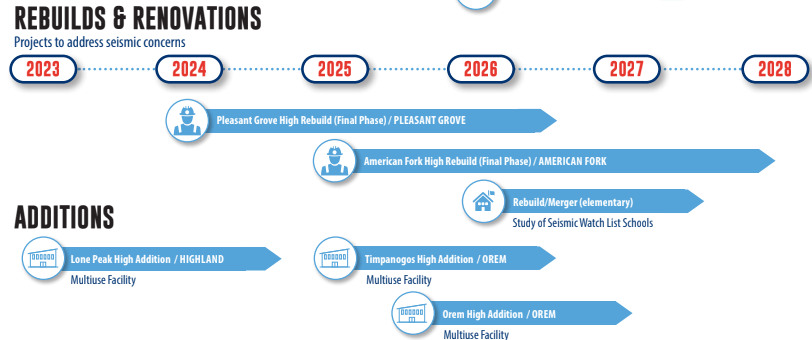
Even if the bond had passed, at least four of these schools would still not have their seismic issues addressed for years to come.
Questions:
- Why has it taken so long (18+ years) to address the URM issues at these schools?
- Why did the 2022 bond prioritize multiuse facilities at Lone Peak, Timpanogos, and Orem high schools over the safety of students?
- What is the best way to move forward from here?
It is concerning that ASD has not made these seismic fixes a higher priority. Instead, it appears that the plan is to close these older schools and/or merge them into larger schools.
Is closing the schools the answer? It may make financial sense on paper. But there is an intangible cost incurred when closing a school.
“Studies have shown that when neighborhoods lose a school, it can hurt property values and tax revenues. Public schools are gathering places that may be sites for other social services such as parent education, job skills classes, health services or distribution points for donations. When students have to travel farther to school, even by half a mile, it can lower participation in enrichment programs and make it harder for parents to get involved.” – Anya Kamenetz, NPR (see also)
One study found that school closures disproportionally affect disadvantaged communities. The study points out that when schools close or merge there is an increase in crime. Is this what we want for Orem, Lehi, Lindon, and Alpine?
A school district division like the ones proposed by the interlocal agreements in ASD would enable each community to refocus on the safety of their schools. It would also allow individuals in the communities closest to these schools to make the decisions of whether to close a school or rebuild it.
 Smaller Schools and Districts
Leave a comment